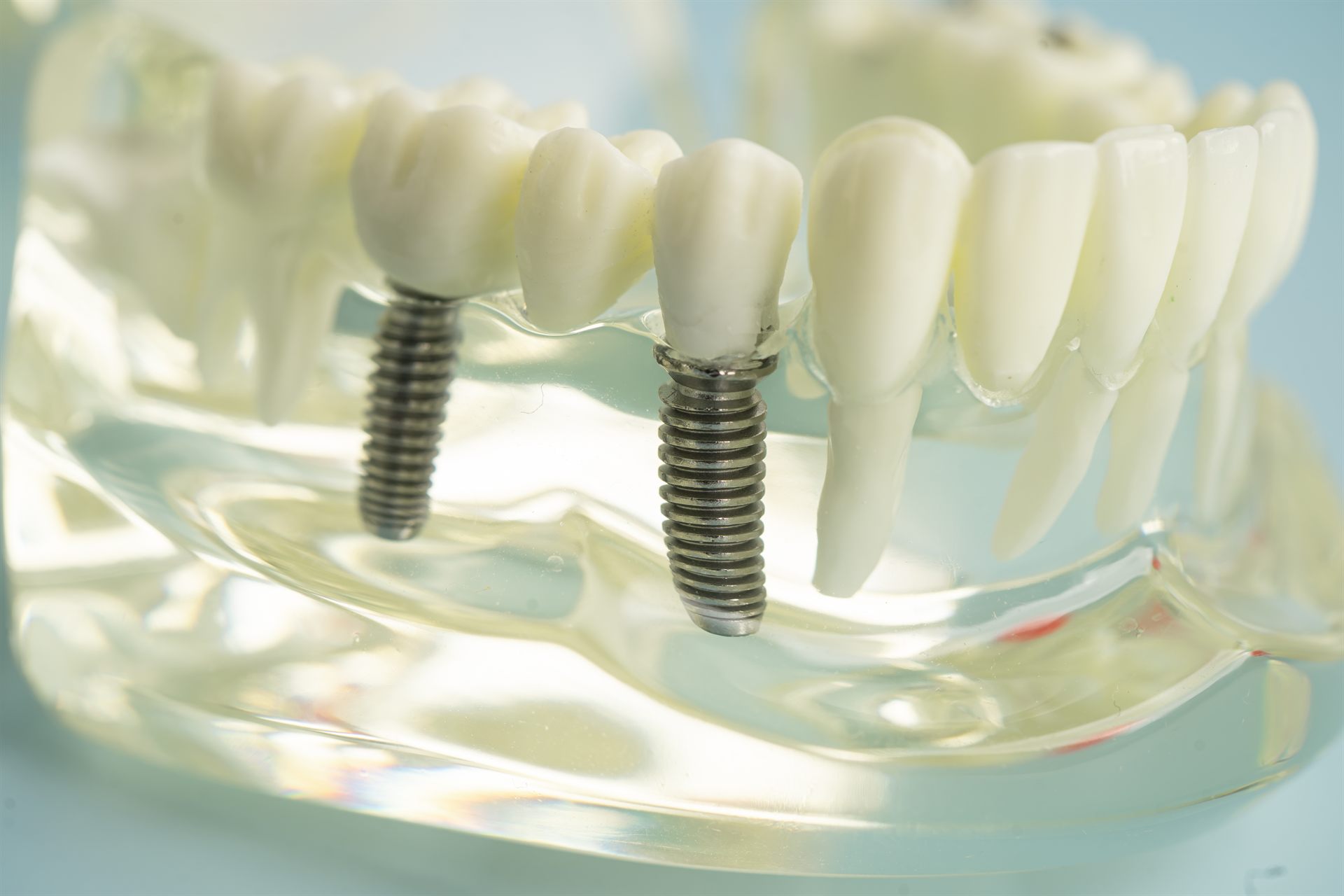
All-on-4 Implant Treatment
For patients who have lost all their teeth — or are about to — All-on-4 is a full-arch technique where a fixed bridge is anchored on just four implants, in most cases on the very same day. Unlike removable dentures that cover the palate, your teeth are fixed: nothing to take out at night, no slipping while speaking, and yes, you can bite into an apple. Because it usually avoids grafting even in resorbed jaws, the technique has become a worldwide standard for full-arch rehabilitation.
- Implants
- 4 per jaw
- Fixed Provisional
- Same day
- Final Bridge
- ~3 months later
- Anaesthesia
- Local / sedation
What Is All-on-4?
All-on-4 is a scientifically documented treatment concept in which a completely edentulous jaw receives a fixed bridge on only four implants. The two front implants are placed vertically, while the two posterior implants are tilted at 30–45 degrees. This angulation avoids anatomical obstacles such as the sinus and nerve canal, and exploits the densest areas of the remaining bone.
The four implants carry a full-arch bridge screwed onto them with balanced load distribution. The technique works in both jaws; when both are treated, a single operation with eight implants in total gives the whole mouth fixed teeth.
Advantages of All-on-4
The biggest advantage is speed: in suitable cases a fixed provisional bridge is fitted the same day the implants are placed, and you leave the clinic with teeth. The second is that tilted placement eliminates the need for bone grafting and sinus lifts in most cases — reducing both treatment time and cost.
The palate-free design markedly improves taste and speech compared with removable dentures. Since only your dentist can remove the bridge, there is no taking it out at night and no adhesives. The implants also stimulate the jawbone through chewing forces, slowing the bone resorption that causes facial collapse.
Who Is a Candidate?
All-on-4 is designed for patients who have lost all their teeth, whose remaining teeth cannot be saved, or who are unhappy with an existing complete denture. There is no upper age limit; anyone healthy enough for minor surgery under local anaesthesia can be assessed.
Advanced bone loss is rarely a barrier — the technique was developed precisely for these patients. Uncontrolled systemic disease and heavy smoking influence planning. Final candidacy is confirmed by measuring bone volume and density on 3D tomography; at the consultation we tell you plainly whether All-on-4, All-on-6 or conventional implants will give you the more predictable result.
Fixed Teeth in a Day: The Process Step by Step
At the planning visit we take 3D tomography, digital scans and photographic analyses; the length, shade and arrangement of your new teeth are designed before surgery. On the day, any unsalvageable teeth are removed, four implants are placed with a surgical guide, and a screw-retained provisional bridge manufactured to your implant positions is fixed in the same session.
For the first 2–3 months you eat mainly soft foods on the provisional bridge while the implants quietly integrate with the bone. Once integration is complete, impressions are renewed and the final bridge — a titanium framework veneered in zirconia or hybrid composite — is produced. The final bridge far exceeds the provisional in aesthetics, chewing efficiency and durability.
At no point in the process do you spend a single day without teeth — it is no coincidence that this is the sentence our patients use most when describing the treatment.
All-on-4 vs Conventional Implants
The conventional approach places 6–8 implants in an edentulous jaw and frequently requires grafting; treatment can stretch over 6–12 months. All-on-4 reduces the implant count to four, eliminates grafting in most cases, and delivers fixed provisional teeth the same day.
That does not make All-on-4 'better' in every case: in young patients with excellent bone, or for individual missing teeth, conventional implants remain the gold standard. The right question is not which technique is newest, but which is most predictable in your anatomy — and we make that call together, with the tomography data on the table.
Aftercare and Longevity
Caring for an All-on-4 bridge is no harder than caring for natural teeth: a soft brush, interdental brushes and a water flosser keep the underside clean daily. We recommend check-ups every 3–6 months in the first year and twice yearly after that, where screw torques and peri-implant tissue health are also verified.
Published 10-year survival rates for All-on-4 implants range between 94–98%. The bridge veneer can be renewed over the years, while the implants themselves are planned to serve for life with regular maintenance. Every All-on-4 patient at DizgeKlinik is enrolled in a lifelong periodic follow-up programme.
Frequently Asked Questions
The questions we hear most at consultations — answered plainly.
Will I really get teeth the same day?
With suitable bone, yes: implants are placed in the morning and the pre-designed fixed provisional bridge is screwed in the same day. In rare cases a short initial healing wait may be advised — a possibility we discuss in advance at planning.
How different is it from a removable denture?
Completely: the bridge is screwed to implants, never comes out at night, leaves the palate uncovered, needs no adhesive, and chewing power approaches natural teeth. Speech and taste feel dramatically more natural than with a removable denture.
My bone loss is severe — is it still possible?
In most cases yes; the tilted posterior implants exist precisely to avoid the resorbed areas. In extreme cases additional solutions such as zygomatic implants are considered. The definitive answer comes from 3D tomography.
How long is surgery and does it hurt?
About 2–3 hours per jaw, painless under local anaesthesia; sedation support is available for patients who prefer it. Post-operative swelling and tenderness typically settle within 3–5 days.
What is the difference between All-on-4 and All-on-6?
All-on-6 distributes the same bridge over six implants; where bone volume allows, it can be chosen for extra load sharing. Which suits you is decided at planning based on bone quality and jaw anatomy.
What can I eat with the provisional bridge?
For the first 2–3 months we recommend soft foods — pasta, fish, eggs, well-cooked vegetables — avoiding very hard or sticky items. Once the final bridge is fitted there are no dietary restrictions.
Let's plan your treatment together
At your free first consultation, our dentists listen first — then we map out your options.