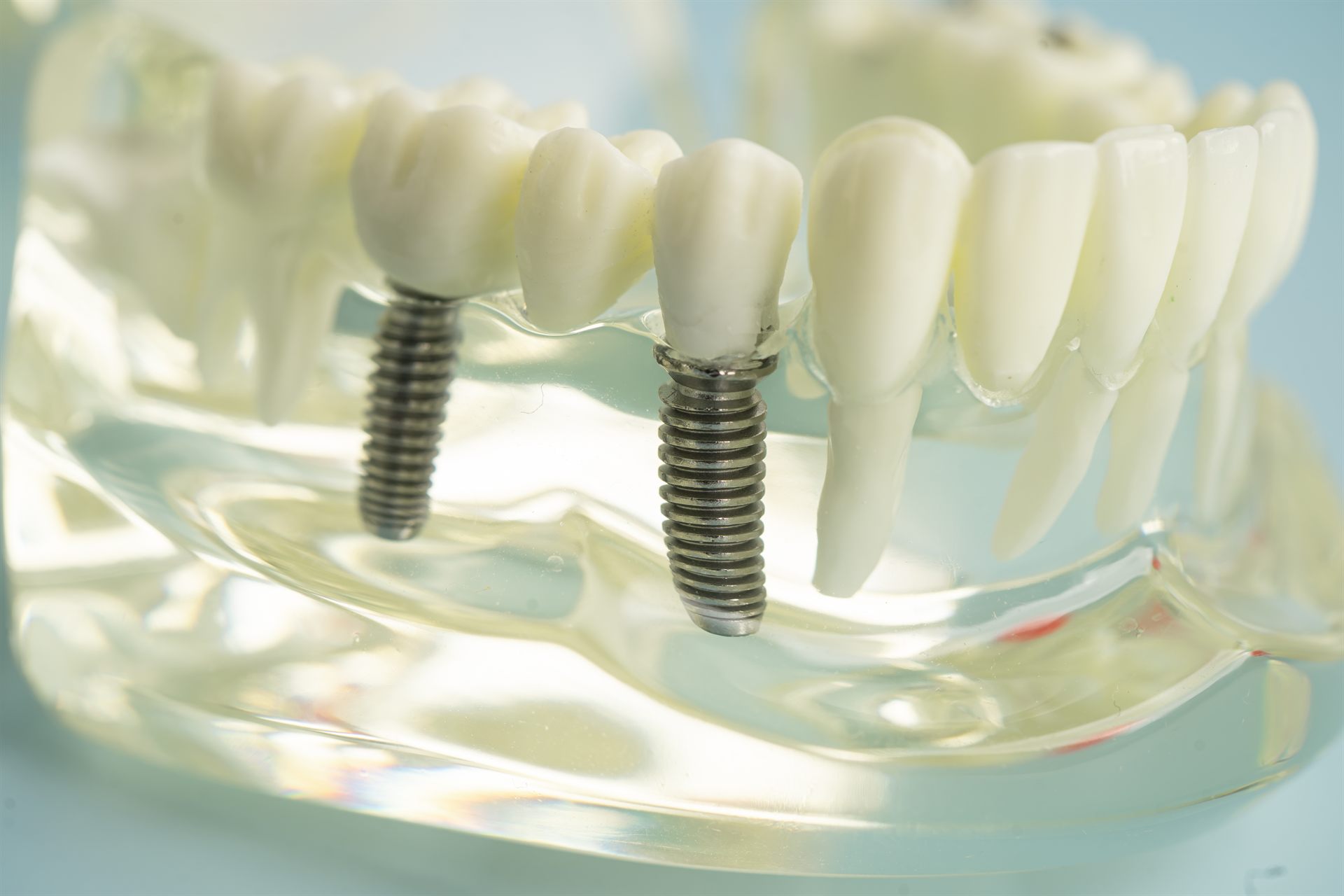
Dental Implant Treatment
Missing teeth affect far more than your smile; they change how you chew, how you speak and how your jawbone ages. Implant treatment rebuilds the lost tooth from the root up with a titanium post, permanently restoring both function and aesthetics. At DizgeKlinik, every implant case is planned digitally on 3D tomography and placed with guided surgery at millimetric precision.
- Procedure Time
- 30–60 min / implant
- Visits
- 2–3 visits
- Anaesthesia
- Local
- Longevity
- Lifelong with proper care
What Is a Dental Implant?
A dental implant is a titanium post placed in the jawbone to take over the role of a natural tooth root after a tooth is lost or extracted. Titanium is a biocompatible material the body does not reject; it chemically fuses with bone and forms an unshakeable foundation for the crown, bridge or denture placed on top.
The most important difference from a conventional bridge is that neighbouring teeth remain untouched. A bridge requires grinding down the two healthy teeth either side of the gap; an implant treats only the missing area. Healthy tooth structure is preserved, and because the bone under the gap keeps receiving chewing forces, it is protected from resorption.
Who Is It Suitable For?
Almost anyone in good general health, with completed jaw development (typically over 18) and sufficient bone volume at the implant site is a candidate. Implants work in every scenario from a single missing tooth to a completely edentulous jaw.
Uncontrolled diabetes, heavy smoking, advanced gum disease or certain bone medications can affect the success rate; these rarely rule treatment out, they simply change the plan. Where bone volume is insufficient, grafting or sinus lift procedures can prepare the site. The final decision is made together with your dentist after 3D tomography and a clinical examination.
How Does Treatment Work at DizgeKlinik?
The process starts with 3D tomography and a digital intraoral scan. Bone density and the position of nerves and sinuses are mapped to the millimetre; the implant's brand, diameter, length and angle are decided on screen before you ever sit in the chair. A personal surgical guide produced from this plan guarantees the implant lands exactly where intended.
Placement is done under local anaesthesia and takes 30–60 minutes per implant on average; most of our patients compare the experience to having a filling. Guided surgery allows flapless or minimal-suture work in most cases — noticeably reducing swelling and discomfort.
During healing, a temporary restoration protects your smile in the aesthetic zone. Once integration is complete, your custom porcelain or zirconium crown is produced from a digital impression and fixed onto the implant.
Healing and Osseointegration
Osseointegration — the implant fusing with bone — takes 2–3 months in the lower jaw and 3–4 months in the upper jaw on average. During this period bone cells envelop the implant until it becomes as solid as a natural root. Mild sensitivity in the first days is easily managed with simple pain relief recommended by your dentist.
For cases that cannot wait out the integration period, immediate-loading protocols are possible when bone conditions allow; this is the standard approach in full-arch treatments such as All-on-4. Which protocol suits you becomes clear at the planning stage, based on your bone quality.
Restoration Options on Implants
For a single missing tooth, a screw-retained or cemented crown is placed on the implant. When several neighbouring teeth are missing, a bridge can rest on two implants — one implant per tooth is not necessary. In complete edentulism, full-arch prostheses fixed on four or six implants (All-on-4 / All-on-6) or implant-retained overdentures come into play.
For crown material we work with zirconium and full-ceramic systems whose translucency is closest to natural enamel. Shade and form are digitally matched to your neighbouring teeth; the goal is that no one can tell which tooth is the implant.
Aftercare and How Long Implants Last
An implant cannot decay, but the gum and bone around it can develop disease just like natural teeth. Daily care is therefore the single biggest factor in implant longevity: brushing twice a day, interdental brushes or floss, and a professional check-up every six months.
Scientific literature reports 10-year implant success rates above 95%; with regular care, implants serve most patients for life. At DizgeKlinik, every implant patient joins a periodic maintenance programme where peri-implant health is measured and tracked at each visit.
Treatment Process
Assessment
Your bone structure is examined with 3D tomography and digital planning.
Placement
The implant is placed with guided surgery under local anaesthesia.
Healing
During 2–3 months of osseointegration, a temporary restoration protects your smile.
Restoration
A custom-made porcelain crown is fixed onto the implant.
Specialised Techniques
Advanced variants of this treatment — explore their dedicated pages.
Frequently Asked Questions
The questions we hear most at consultations — answered plainly.
Is getting an implant painful?
No. The procedure is performed under local anaesthesia and is painless. Mild sensitivity over the following day or two is controlled with simple pain relief; most of our patients return to normal life the next day.
How long does the whole treatment take?
Placement takes 30–60 minutes per implant. Bone integration takes 2–3 months in the lower jaw and 3–4 in the upper; the final crown is then delivered in 1–2 visits. In suitable cases a same-day temporary tooth is possible.
What if I don't have enough bone?
Usually it still can be done. Missing bone is compensated with grafting, sinus lifts, or angled-implant techniques such as All-on-4. The right method is chosen based on 3D tomography analysis.
Can the body reject an implant?
Titanium is biocompatible and is not 'rejected' in the classic sense. Rare integration failures are usually linked to infection, smoking or uncontrolled systemic disease, and can usually be resolved with a new implant.
Should I choose an implant or a bridge?
For preserving healthy neighbouring teeth, preventing bone loss and long-term durability, implants are the first choice in most cases. Bone conditions, timing and budget all play a role though — we compare both options for you at the consultation.
I smoke — can I still get implants?
Yes, but smoking is one of the most significant factors reducing integration success. We recommend pausing for at least two weeks before and after surgery; your dentist will assess your individual risk.
Let's plan your treatment together
At your free first consultation, our dentists listen first — then we map out your options.