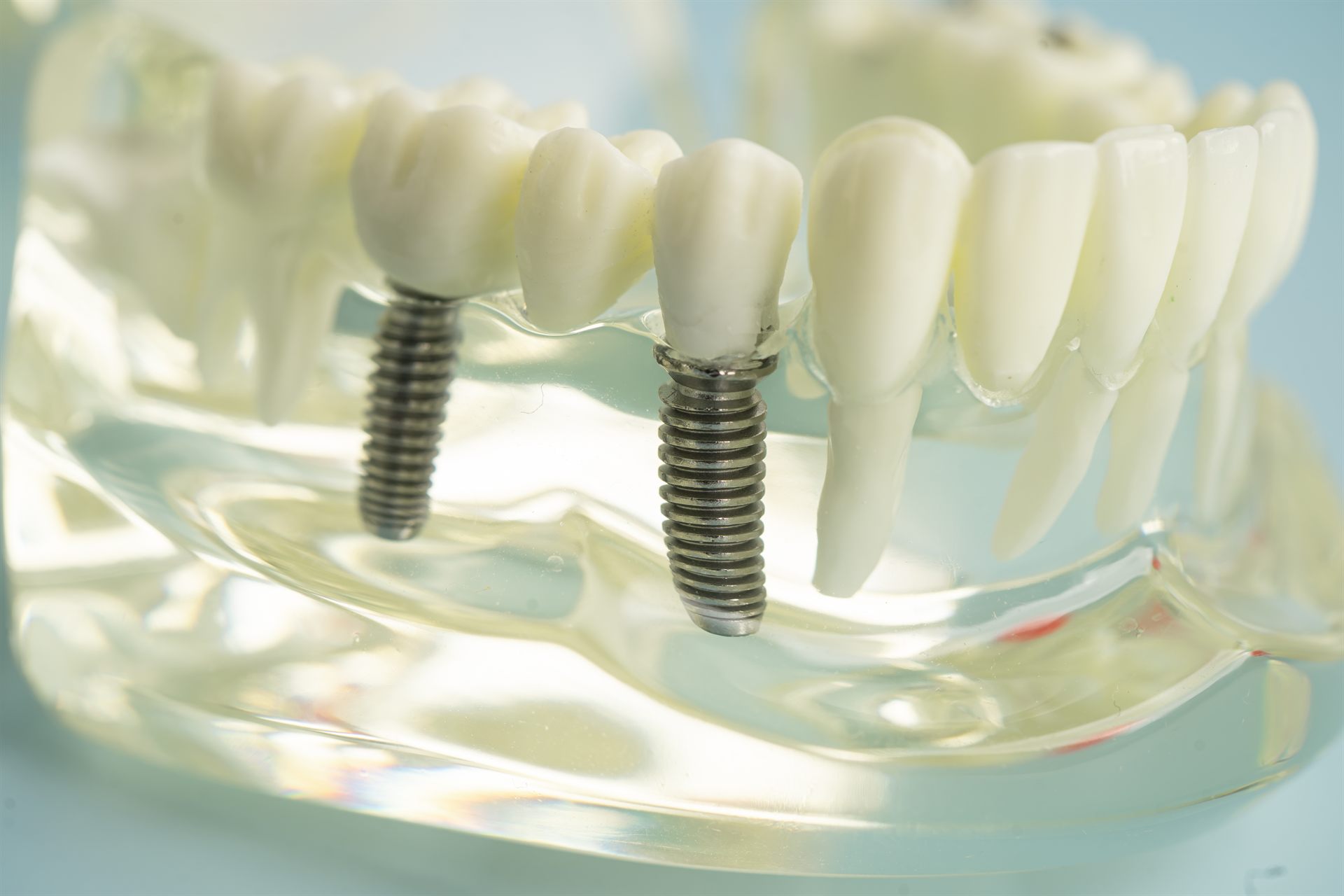
All-on-6 Implant Treatment
When an entire jaw has lost its teeth, All-on-6 anchors a fixed full-arch bridge on six implants. The two additional implants spread chewing forces across more support points, reinforcing the framework that carries your new teeth. Patients with favourable bone volume can, in suitable conditions, leave the clinic with fixed provisional teeth the same day. At DizgeKlinik we plan every All-on-6 case on 3D tomography data, positioning each of the six implants in the strongest zones of your bone.
- Implants
- 6 per jaw
- Fixed Provisional
- Same day when suitable
- Bone Requirement
- Adequate volume needed
- Final Bridge
- ~3–4 months later
What Is All-on-6?
All-on-6 is a full-arch rehabilitation technique in which a fixed bridge in a completely toothless jaw is carried by six implants. The implants are spread evenly along the arch; the bridge screwed onto them replaces every tooth as one piece. Unlike a removable denture, the palate stays open, nothing shifts as you speak or chew, and the restoration comes out only at the clinic.
The name explains the concept: all the teeth of one jaw rest on six implants. It belongs to the same family as All-on-4; the difference lies in the number of supporting implants and, with it, the number of points sharing the chewing load. The technique can be applied to the lower jaw, the upper jaw or both.
Why Six Implants? The Power of Load Distribution
The forces generated during chewing are greater than most people imagine, and in a full-arch restoration the implants absorb all of them. With six supports instead of four, the load on each individual implant drops, bending stresses within the bridge framework shrink, and force is spread more evenly around the dental arch. This mechanical relief means both the bone around the implants and the veneering material of the bridge are strained less over the years.
Six anchor points also give the prosthetic design more freedom: the bridge can extend further back, creating a wider chewing surface in the molar region. And should one implant ever be lost, the remaining five can usually continue to carry the bridge — a built-in safety margin for the treatment.
Who Is a Good Candidate?
The prerequisite for All-on-6 is bone volume sufficient to place six implants without grafting, or with only limited grafting. Patients whose bone is relatively well preserved — often those who lost their teeth recently or are about to lose them — are the strongest candidates. The extra anchorage is particularly valuable in long dental arches and in patients who generate powerful chewing forces or habitually clench and grind.
The upper jaw, with its naturally softer bone, often benefits most from the additional support six implants provide. General health requirements are the same as for any implant surgery; well-controlled chronic conditions are rarely an obstacle. Before recommending a concept, we review your tomography images with you and listen to your expectations and habits.
From Planning to Final Bridge: The Treatment Journey
Planning starts on screen: tomography images and digital scans let us decide the position, angle and length of all six implants virtually, and the design of your new teeth is approved by you before surgery. On the operation day, teeth that cannot be saved are removed and the implants are guided into their planned positions.
If the implants achieve adequate initial stability, the pre-fabricated screw-retained provisional bridge is fitted in the same session. Through the three-to-four-month integration period you speak, smile and eat soft foods with this provisional. Impressions are then renewed digitally, and your final bridge — built on a titanium or zirconia framework — is crafted in the laboratory, fine-tuned and delivered.
At follow-up visits we monitor both the tissues around the implants and the balance of your bite; any small refinements are carried over into the final bridge. Our goal is that you finish treatment not just with fixed teeth, but with a smile that chews comfortably and looks natural.
All-on-4 or All-on-6? An Honest Comparison
Both concepts reach the same destination — a fixed full-arch bridge — so choosing between them is a question of anatomy, not a ranking of quality. All-on-4 opens the way to graft-free treatment when the posterior bone has resorbed, thanks to its tilted implants. All-on-6 rewards patients who still have adequate bone with more support points and a bridge body that can reach further back.
Forcing six implants into a jaw that cannot house them is poor planning — and so is ignoring the extra support when the bone would happily accept it. At DizgeKlinik we base this decision not on marketing labels but on your bone map from tomography, the teeth in the opposing jaw and your chewing habits. At the consultation we lay out the pros and limits of each scenario for your case.
Care, Check-ups and Long-Term Success
What determines the lifespan of a fixed full-arch bridge more than anything else is daily cleaning of the zone where the bridge meets the gum. A water flosser, super floss and interdental brushes are the most practical tools for this area; at the delivery visit we show you, hands-on, which combination works for you. For patients who clench or grind, a night guard may be recommended — a simple measure that protects the bridge veneer for years.
Our check-up programme is more frequent in the first year, then settles at six-month intervals. At these visits we assess the bone levels around each implant, gum health and the bridge screws; when needed, the bridge is removed for professional cleaning and refitted. Long-term success rates for full-arch implant bridges are consistently high in the literature, and a steady home-care and check-up routine keeps that success alive in your mouth.
Frequently Asked Questions
The questions we hear most at consultations — answered plainly.
Is All-on-6 better than All-on-4?
No — they are equivalent concepts serving different anatomies. With good bone volume, All-on-6 adds support; where the posterior bone has shrunk, All-on-4's tilted implants can be the smarter route. The real answer sits in your tomography analysis.
Do I also get same-day teeth with All-on-6?
Yes — if the implants lock in with sufficient stability at placement, the screw-retained provisional bridge is fixed in the same session. If stability is borderline, the teeth are attached after a short healing interval — you will know about this possibility before surgery, never as a surprise.
What if my bone is not enough for six implants?
There are two routes: the missing volume can be rebuilt with localized grafting or a sinus lift, or the plan can shift to a concept using fewer implants, such as All-on-4. We evaluate which path is more predictable for you using tomography measurements.
Is the surgery harder than All-on-4?
Not in any way you would notice as a patient. Two extra implants add some operating time, but the procedure remains comfortable under local anaesthesia, with sedation available if you prefer it. The recovery experience is very similar.
How do I clean under the bridge?
A water flosser and super floss form the core of daily cleaning; a short morning-and-evening routine keeps the area under the bridge hygienic. At the delivery visit we demonstrate every tool directly in your mouth, and we review your technique together at check-ups.
How long does an All-on-6 bridge last?
The implants themselves can stay trouble-free for decades when the maintenance routine is respected. Wear on the veneering surface is handled by repair or renewal while the framework stays in place — so think of the bridge as a serviceable long-term system rather than a one-off product.
Let's plan your treatment together
At your free first consultation, our dentists listen first — then we map out your options.